By Rachel Drummond
How Medical and Healthcare Brands Benefit from Digital Marketing Agencies
Reading time: 9 minutes
Ever tried explaining HIPAA compliance to a marketing intern? Or watched a brilliant physician’s practice get buried on page four of Google while a competitor with worse outcomes dominates local search? You’re not alone. Healthcare marketing in 2026 is a strange beast—part regulated industry, part trust-building exercise, part digital arms race.
Let’s break down why medical and healthcare brands are increasingly turning to specialized digital marketing agencies instead of building everything in-house, and how that decision translates into real patient growth.
Table of Contents
- Why Healthcare Marketing Is Different
- The Core Benefits Agencies Bring
- Real-World Scenarios and Case Examples
- Agency vs. In-House: A Side-by-Side Look
- Common Challenges (and How Agencies Solve Them)
- Frequently Asked Questions
- Your Roadmap Forward
Why Healthcare Marketing Is Different
Marketing a med spa or an orthopedic clinic isn’t like promoting a shoe brand. There’s a regulatory minefield (HIPAA, FTC guidelines, state medical board advertising rules), a skeptical audience that’s researching symptoms at 2 a.m., and a sales cycle built almost entirely on trust rather than impulse.
According to a 2026 industry survey from the Healthcare Marketing Alliance, 78% of patients research a provider online before booking, and nearly half say they’ve ruled out a practice because of an outdated or confusing website. That’s not a minor detail—that’s lost revenue happening silently, every single day.
Well, here’s the straight talk: healthcare organizations that treat digital marketing as an afterthought are essentially leaving their front door unlocked while competitors roll out the welcome mat.
The Trust Deficit Problem
Patients aren’t just choosing a service; they’re choosing someone to trust with their health. Generic marketing tactics—flashy banners, aggressive pop-ups, exaggerated claims—actively erode that trust. This is precisely where specialized agencies earn their keep: they understand the psychology of a worried patient, not just the mechanics of a Google Ads campaign.
The Core Benefits Agencies Bring
1. Regulatory-Savvy Content Creation
A generalist copywriter might write a blog post claiming a treatment “cures” a condition—an innocent word choice that can trigger FTC scrutiny or violate advertising statutes in several states. Healthcare-focused agencies build content workflows with compliance checkpoints baked in, so practices avoid costly rewrites, takedowns, or worse, legal exposure.
2. Local SEO That Actually Understands Patient Intent
Healthcare search behavior is intensely local and symptom-driven (“emergency dentist near me open now,” “pediatric allergist accepting new patients”). Agencies specializing in this space optimize Google Business Profiles, manage review generation, and build location pages that convert—rather than generic SEO tactics borrowed from e-commerce playbooks.
3. Multi-Channel Patient Acquisition Funnels
From paid search to retargeting to email nurture sequences for post-consultation follow-up, agencies build connected systems. A single Facebook ad rarely fills a schedule—but a coordinated funnel that nurtures a lead from “curious” to “booked appointment” consistently does.
4. Reputation Management at Scale
One bad review can outweigh ten good ones in a patient’s mind. Agencies deploy structured review-request systems, respond diplomatically to criticism (without violating patient privacy), and turn satisfied patients into vocal advocates.
Real-World Scenarios and Case Examples
Scenario 1: The Regional Orthopedic Group
A multi-location orthopedic practice in the Midwest partnered with a healthcare-focused agency in early 2025 after noticing new patient volume had plateaued. The agency rebuilt location-specific landing pages, launched a review-generation campaign, and restructured Google Ads around high-intent procedures like “knee replacement recovery time.” Within eight months, the group reported a 34% increase in new patient consultations and a 22% drop in cost-per-acquisition.
Scenario 2: The Telehealth Startup
A telehealth mental health platform launching in 2026 needed to scale fast without burning through venture funding. Rather than hiring a full internal marketing team, they engaged an agency for performance marketing and content SEO. The agency’s phased approach—starting with organic content authority, then layering paid acquisition—helped the platform reach profitability on customer acquisition cost within 14 months, roughly 40% faster than their initial internal projections.
Scenario 3: The Solo Dermatology Practice
A solo dermatologist struggled with inconsistent bookings for cosmetic procedures. An agency introduced a segmented email nurture campaign and Instagram content strategy showcasing before/after results (fully compliant with state advertising rules). Bookings for elective procedures rose by 28% in one quarter, smoothing out the previous seasonal dips.
Agency vs. In-House: A Side-by-Side Look
| Metric | In-House Team | Specialized Agency |
|---|---|---|
| Average Time to Launch Campaign | 6–10 weeks | 2–3 weeks |
| Compliance Expertise (HIPAA/FTC) | Often limited | Built into workflow |
| Annual Cost (Mid-Size Practice) | $180K–$260K (salaries + tools) | $60K–$120K (retainer) |
| Access to Multi-Channel Expertise | 1–2 specialties typically | Full-stack team access |
| Reporting & Analytics Maturity | Varies widely | Standardized dashboards |
Patient Acquisition Channel Performance (2026 Benchmark Data)
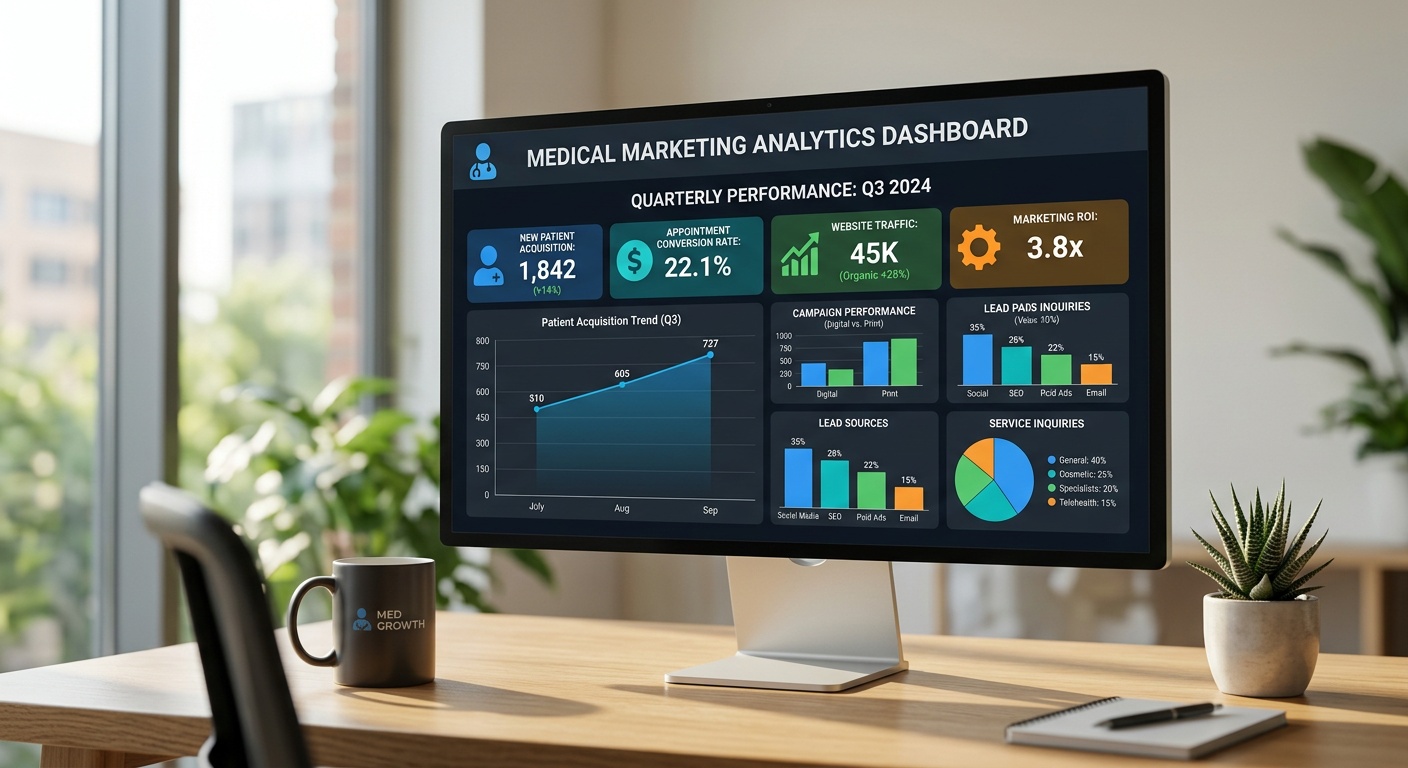
Below is a simplified visualization comparing average patient inquiry conversion rates by channel, based on aggregated 2026 healthcare marketing benchmarks.
Common Challenges (and How Agencies Solve Them)
Challenge 1: Fragmented Data Across Locations
Multi-location healthcare brands often struggle with siloed data—one location tracks calls, another tracks form fills, none of it talks to each other. Agencies typically implement unified attribution dashboards, giving leadership a single source of truth for what’s actually driving bookings.
Challenge 2: Staff Turnover Disrupting Marketing Continuity
When an in-house marketing coordinator leaves, campaigns often stall for weeks. Agencies provide institutional continuity—strategy documents, brand guidelines, and campaign history live with the agency, not a single employee’s inbox.
Challenge 3: Balancing Compliance With Compelling Messaging
It’s tempting to think compliance and persuasive marketing are at odds. They’re not. As one healthcare marketing strategist put it in a 2026 industry panel: “The best healthcare marketing doesn’t skirt the rules to sound compelling—it finds compelling truths within the rules.” Agencies with healthcare-specific experience know how to highlight genuine outcomes, patient testimonials (properly consented), and provider credentials without overstepping legal lines.
Frequently Asked Questions
Is it worth hiring an agency if our practice is small and local?
Yes, often more so than for larger systems. Small practices frequently lack the budget for a full in-house team, so an agency retainer covering SEO, reputation management, and basic paid ads can outperform a single generalist hire, especially when local competition for search visibility is intense.
How long before we see measurable results?
Paid campaigns can show movement within 30–60 days, while organic SEO and content authority typically take 4–8 months to meaningfully shift rankings and traffic. A trustworthy agency will set these expectations upfront rather than promising overnight transformation.
Can an agency really understand HIPAA and industry regulations as well as our compliance team?
A specialized healthcare marketing agency won’t replace your compliance officer, but the strong ones work collaboratively with legal and compliance teams, building review processes for ads, landing pages, and testimonials so nothing goes live without proper vetting.
Your Roadmap Forward
Healthcare marketing in 2026 isn’t about choosing between “clinical credibility” and “digital growth”—the brands winning right now have figured out how to have both. Here’s your practical next-step checklist:
- Audit your current digital presence — check Google Business Profile accuracy, website load speed, and mobile usability this week.
- Request agency case studies specific to healthcare — generic marketing wins don’t translate directly; ask for outcomes from practices like yours.
- Clarify compliance workflows upfront — ask any prospective agency exactly how they vet content before publishing.
- Set realistic 90-day and 12-month benchmarks — align on what success actually looks like before signing a contract.
- Start with one channel, then expand — local SEO or reputation management is often the fastest, lowest-risk starting point.
The clinics and health systems that thrive over the next few years won’t necessarily be the ones with the biggest budgets—they’ll be the ones that treat digital trust-building as seriously as clinical excellence. So, where does your practice currently stand: still patching together marketing on the side, or ready to build a system that actually earns the patients you deserve?